

Turning an agricultural challenge into an opportunity for farmers, rural communities and the environment
Punjab has always been known for its contribution to the food security of the country. The hard work of its farmers, the productivity of its fields and the agricultural infrastructure developed over the years have made the state one of the most important contributors to India's food production. However, every agricultural achievement also brings its own challenges, and one of the biggest concerns facing Punjab today is the management of paddy straw after the harvesting of rice.
Every year, Punjab produces about 20 million tons of paddy straw. Of this, around 12-13 million tons is managed through in-situ and ex-situ practices, while the remaining quantity is burnt in the fields. Stubble burning has therefore become a serious concern for farmers, the government and the people of Punjab. The challenge is not simply to stop farmers from burning paddy straw; it is to create practical, sustainable and economically viable alternatives through which this agricultural residue can be put to productive use.
This is where renewable energy projects, particularly Biomass Power Projects and Compressed Biogas (CBG) plants, are emerging as an important part of the solution. The Government of Punjab, through the Punjab Energy Development Agency (PEDA), is promoting and developing these projects with the objective of mitigating stubble burning and ensuring the scientific disposal of paddy straw. The idea is to turn what is presently considered agricultural waste into a valuable resource.
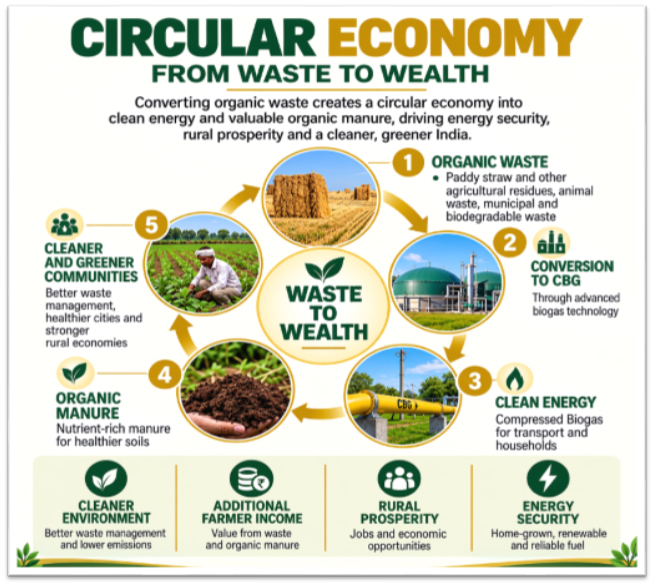
The figures themselves explain why Punjab needs a large-scale and organised solution. Managing such a huge quantity of agricultural residue requires more than awareness campaigns or individual efforts. It needs infrastructure, technology, investment and a system that can connect farmers with industries capable of consuming paddy straw. Biomass Power Projects and CBG plants offer two important avenues for achieving this objective by creating demand for paddy straw and providing a pathway for its utilisation beyond the farm.
Instead of treating the residue as something that must be disposed of immediately after harvesting, it can become a raw material for renewable energy production. The scale of the projects being promoted in Punjab reflects the seriousness of this effort and the need to develop multiple technologies so that more of the straw generated each year can be put to productive use.
Punjab already has 11 operational Biomass Power Projects with a combined capacity of 101.50 MW. These projects consume approximately 12 lakh tons of paddy straw annually, making an important contribution towards agricultural residue management. Their operation demonstrates how paddy straw can be utilised as a resource for generating power rather than being burnt in the fields.
The significance of these projects goes beyond their installed capacity. They establish a practical mechanism through which agricultural residue can be collected and supplied for productive use. For Punjab, the continued development of biomass-based energy infrastructure can play an important role in addressing the challenge of paddy straw management. At the same time, the scale of residue generated every year makes it necessary to explore additional technologies and create more avenues for utilisation. Compressed Biogas is one such promising avenue.
Compressed Biogas, commonly known as CBG, is produced through advanced biogas technology using organic material. In Punjab, paddy straw is an important feedstock for these projects. The technology provides a way to convert agricultural residue into clean energy while also generating useful organic manure.
The state has allocated 55 paddy straw-based CBG projects with a total capacity of approximately 800 Tons Per Day (TPD). Together, these projects are expected to consume around 27 lakh tons of paddy straw annually. The project pipeline is substantial, and the progress made so far is encouraging. Out of the 55 allocated projects, eight projects with a combined capacity of 115 TPD are operational and presently consume approximately 2.7 lakh tons of paddy straw annually. Three projects with a total capacity of 30 TPD are expected to become operational by 2026-27, while 44 projects with a combined capacity of 655 TPD are at various stages of execution and are expected to become operational over the next two to three years.
These figures indicate the scale of the infrastructure being developed in Punjab. As more projects become operational, the CBG sector is expected to create additional demand for paddy straw and strengthen the state's efforts towards its scientific management. The coming years will be important in determining how effectively this infrastructure translates into actual residue utilisation on the ground.
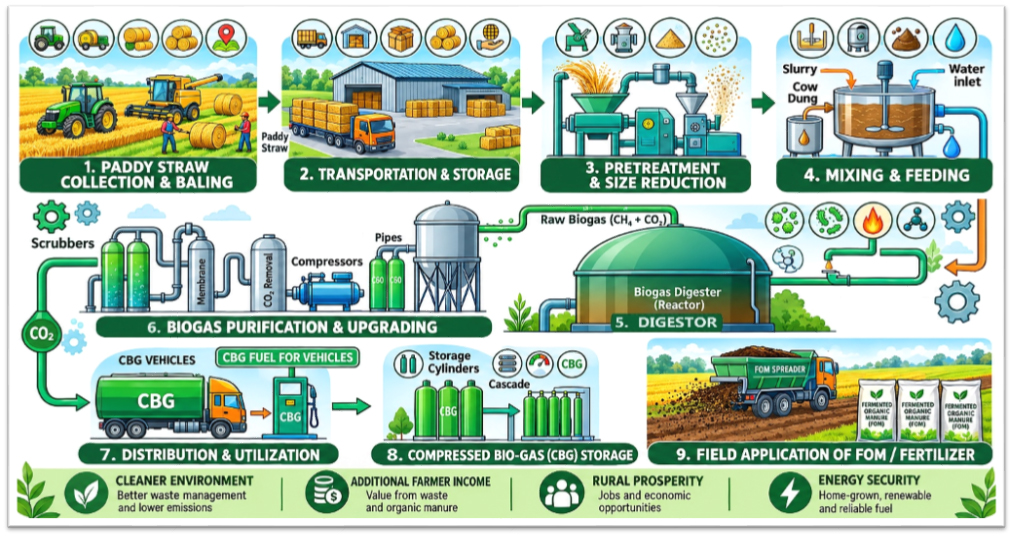
For many people, the working of a CBG plant may appear complicated, but the process follows a series of well-defined steps. It begins with the collection of paddy straw from agricultural fields. The straw is transported to the plant and stored before being subjected to pre-treatment and size reduction, which prepares the material for the next stage of processing.
The prepared feedstock is then mixed with slurry and other required inputs before being fed into a biogas digester. Inside the digester, organic material undergoes a biological process that produces raw biogas, primarily containing methane and carbon dioxide. The raw biogas is then purified and upgraded to remove unwanted components, including hydrogen sulphide and carbon dioxide. The resulting gas is compressed and stored before being distributed for utilisation.
The process also produces digestate, which can be processed into Fermented Organic Manure (FOM). In simple terms, a CBG plant takes paddy straw from the fields, converts it into energy and produces an organic material that can be used in agriculture. This is the essence of a circular economy: using resources more efficiently and ensuring that the output of one process becomes a useful input for another.
One of the important aspects of CBG plants is the production of Fermented Organic Manure. There is a common misconception that FOM has little value or is not useful for agricultural fields. However, the project information highlights its potential as nutrient-rich, eco-friendly manure that supports sustainable agriculture.
FOM contains organic carbon that can help replenish soil organic matter. It can contribute towards improving soil structure, moisture retention and nutrient use over time. It can also be enriched with specific nutrients and used alongside chemical fertilisers. Further, its composition can be customised according to different crops and agricultural requirements.
For a state like Punjab, where agriculture remains central to the economy and rural life, the utilisation of organic manure is an important part of the larger discussion around sustainable farming. CBG plants, therefore, are not merely energy-producing facilities; they also provide an opportunity to return useful organic material to agricultural fields. The process creates a connection between the farm, the energy plant and the farm once again.
The development of CBG infrastructure is not limited to figures on paper. Projects are also taking shape at different locations in Punjab. A 20 TPD CBG capacity project at Village Baroti, Tehsil and District Hoshiarpur, is one of the projects highlighted in the project details.
Another project is located at Village Ghungrali Rajputan, Tehsil Khanna, District Ludhiana, with capacity of 12 TPD
These projects reflect the development of paddy straw-based CBG infrastructure in different parts of the state. Their importance lies in creating facilities closer to the agricultural areas from where biomass can be sourced. The development of such projects also brings the larger concept of renewable energy into the rural landscape. The photographs of these facilities show the scale of infrastructure required for biomass processing, gas production, storage and distribution.
The benefits of biomass-based projects should not be viewed only through the lens of energy generation. The circular economy model brings together several interconnected outcomes. Paddy straw and other organic waste become the raw material for energy production. The resulting biogas is converted into compressed biogas for transport and household applications, while the organic manure produced through the process can be used in agricultural fields.
This creates an opportunity for additional farmer income through the utilisation of agricultural residue and organic manure. The development of such projects also creates opportunities for rural employment and economic activity. At the same time, better management of agricultural residue can contribute towards cleaner surroundings and reduced dependence on the practice of burning paddy straw.
The larger objective is to create a system in which agricultural waste is not simply discarded but becomes part of an organised economic activity. For Punjab, this approach has the potential to bring together agriculture, renewable energy and rural development.
Punjab has made a significant beginning in developing biomass-based renewable energy infrastructure. The 11 operational Biomass Power Projects, the 55 allocated CBG projects and the progress of projects at various stages of execution demonstrate the direction in which the state is moving. The immediate task is to ensure that projects under execution become operational as planned and that the infrastructure created is able to utilise paddy straw effectively.
The success of this initiative will ultimately depend on how efficiently the entire system works from the collection and transportation of paddy straw to its processing and the utilisation of the final products. The figures are encouraging, but the real measure of success will be the quantity of paddy straw that is actually diverted from burning and put to productive use.
There is also a need to create greater awareness about the value of CBG and the organic manure produced by these plants. Farmers and rural communities must understand that paddy straw is not merely a residue left behind after harvesting; it can become an economic resource.
Punjab's agricultural strength has always been built on the ability of its farmers to adapt, innovate and respond to changing circumstances. The challenge of paddy straw management requires the same spirit. Biomass Power Projects and Compressed Biogas plants offer a practical way of connecting agricultural residue with renewable energy production and organic manure.
The approach being promoted by the Government of Punjab and PEDA represents an important step towards scientific waste management, cleaner energy and a more sustainable rural economy. The vision is not merely to find an alternative to stubble burning, but to create a system in which agricultural residue becomes a resource, energy is produced from waste, organic manure returns to the fields and rural communities benefit from new economic opportunities.
In the long run, the success of this effort will depend on turning the infrastructure being developed today into a reliable and efficient system on the ground. Punjab has the agricultural residue, the need and the beginnings of the infrastructure. The opportunity now is to convert this challenge into a lasting source of energy, income and environmental improvement.
From paddy straw to power, from agricultural waste to compressed biogas, and from residue to organic manure, this is the circular economy in action and an opportunity for Punjab to turn a long-standing challenge into a productive resource.